SCREEN EVIDENCE — HIGHLIGHTED
Prots turns screen evidence, application data, and user actions into persistent structured state and explicit changes for AI agents.
Designed for lower observation latency, fewer tokens, and smaller context updates.
Local-first prototype • Source-grounded state • Explicit deltas
The left side shows normal desktop activity. The right side visualizes the structured state Prots derives from it.
A silent, captioned walkthrough of screen evidence becoming structured state.
Open the MP4 directlyThe right pane is a visualization for humans. Agents receive the underlying structured events—not another screenshot.
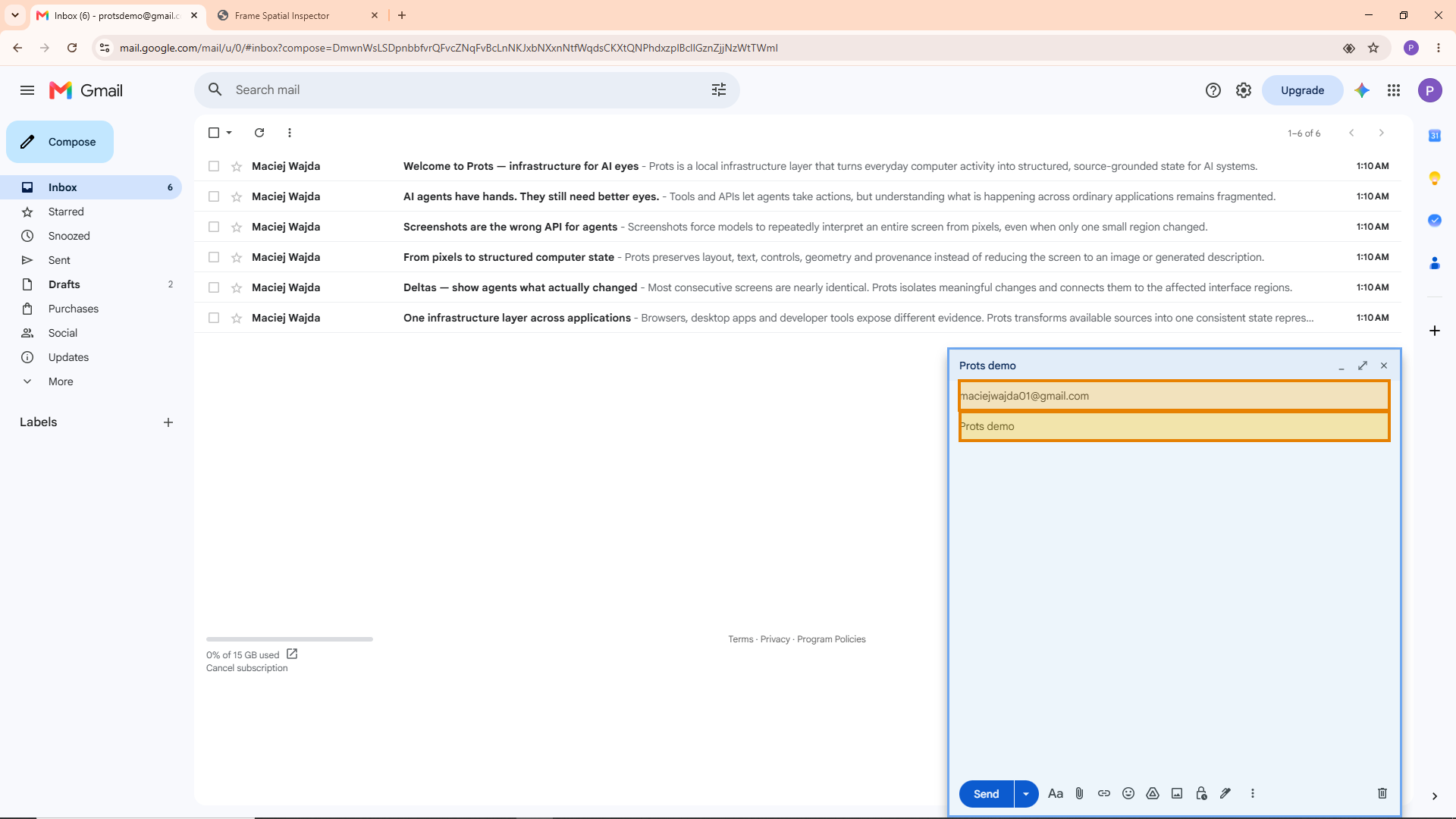
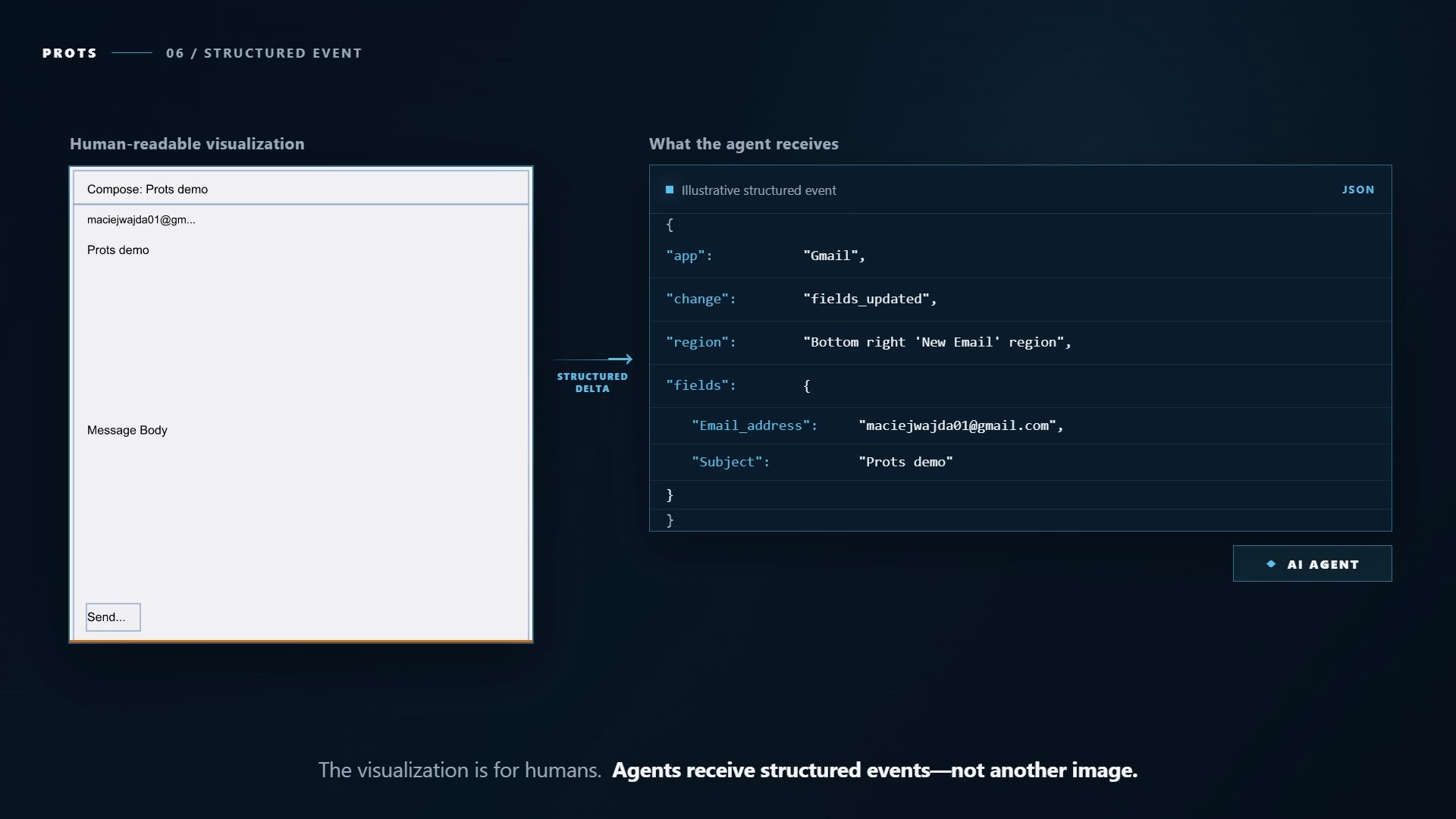
The highlighted screenshot and illustrative JSON connect one visible change to the structured event an agent can receive.
"app": "Gmail","change": "fields_updated","region": "Bottom right 'New Email' region","fields": {"Email_address": "maciejwajda01@gmail.com","Subject": "Prots demo"}Most computer-use agents see pixels. From those pixels, they must reconstruct what exists and what happened.
Prots maintains a continuous state stream built from screen evidence, application data, spatial structure, user actions, and temporal changes.
Built for computer-use agents, browser agents, desktop automation, agent evaluation, and multimodal interaction systems.
Bring a browser or desktop workflow relevant to your agent. I will run it through the current Prots prototype and show how it can be represented as persistent state and explicit changes rather than repeated screenshots.
No installation is required for the initial evaluation.
Evaluate a workflowCurrent prototype inputs and outputs are labeled separately from adapter and interface directions.
Captured local pixels as spatial evidence.
Accessibility-derived controls and text.
Native layout regions and geometry.
Actions aligned with observed changes.
First-class browser structure adapter.
Additional fallback evidence path.
Specialized developer-work adapters.
Inspectable state derived from evidence.
Meaningful affected-region changes.
Agent-readable timestream text and artifacts.
Productized developer interface.
A future agent-tool interface direction.
Developer-defined evidence sources.
| Comparison dimension | SCREENSHOT LOOP | PROTS STATE |
|---|---|---|
| Representation | ▧Pixels or image descriptions | ⌗Structured, source-grounded state |
| State over time | ▧Reconstructed repeatedly | ⌗Persistent between observations |
| Change handling | ▧Compare or reinterpret full frames | ⌗Explicit affected changes |
| Efficiency goal | ▧Repeated screen interpretation | ⌗Designed for lower latency, fewer tokens, and smaller context updates |
If computer-use AI becomes continuous, each system will need a reliable way to understand changing interfaces, preserve context, and verify what happened. Prots is building that layer.
Recognize relevant changes without requiring the user to reconstruct the situation.
Follow approved context across browser, email, editor, terminal, and desktop tools.
Inspect explicit state changes after clicking, typing, or navigating.
Keep processing local and expose only approved fields, changes, or events.
A working local Windows prototype maintains structured state and explicit deltas. Broader application coverage and production hardening remain in progress.
No. Screen pixels can remain evidence; Prots prevents downstream agents from having to reconstruct everything from full frames alone.
No. The reconstruction is a human-readable visualization of the underlying state. Agents receive structured events or state rather than a rendered image of that visualization.
Structured state and explicit change events, with evidence and uncertainty where available.
Not yet. Current coverage depends on available evidence. Prots is designed around multiple source adapters, explicit provenance and honest blocked or partial states.
It is a working local Windows prototype. Broader coverage, interfaces, and production hardening are still in progress.
I am Maciej Wajda, a mathematics student at the Technical University of Munich building Prots as an experimental infrastructure layer for AI agents.
Bring a workflow to evaluate, or get in touch to discuss a technical integration.